The Time is NOW to Close the Dehiwala Zoo
Overview
Join thousands of compassionate and concerned citizens of Sri Lanka and the world who have come together to call for the closure of the Dehiwala Zoo. Together, we appeal for:
Free the Innocent
Over the years, concerned citizens of Sri Lanka, organizations, visitors to the Zoo and the media have highlighted issues of suffering and inadequate care at the Dehiwala Zoo, which we have brought to the attention of authorities time and again. These criticisms, appeals, requests and recommendations have all been largely ignored. The Zoo authorities, seemingly immune to the growing chorus of tens of thousands of voices from across the country and the world, continue on with a business-as-usual attitude. In the face of inaction, the animals at the Dehiwala Zoo continue to suffer in silence: some visibly in pain from injuries and illness; some in cramped or over-crowded conditions; some in solitary confinement; some in spaces so constrained that they can barely move; some tied to the same spot for decades; some in concrete pits; some separated from their newborn offspring; many without adequate food or water; and all visibly distressed and depressed. The Dehiwala Zoo has become a place of suffering for all its animals from the largest to the smallest.
The recent exposé of the Dehiwala Zoo by journalists at LT Magazine (lt.lk/2016/04/foreword-no-cages/) has brought the Zoo global attention. Compassionate Sri Lankans are now not alone in calling for its closure. International animal welfare and wildlife conservation organizations such as The Born Free Foundation UK and PETA Asia have joined the call.
In response, government officials have stated that the Zoo provides "education" and "entertainment" to Sri Lanka's underprivileged children, and therefore it should not be shut down. It is time for the Sri Lankan government to stop exploiting our most vulnerable — our children from disadvantaged and remote parts of the island — in order to keep the Dehiwala Zoo in operation under the guise of an "education" that the majority of Sri Lankans know to be inadequate, misleading and cruel. Instead, we request that you consider giving all our children the right education.
The Right Education
The decision to bring to your attention the need to close the Dehiwala Zoo was not easy for me. Almost 40 years ago, I used to be a volunteer there. Our job as volunteers was to walk the baby animals and keep them with us in the kids play area so that children could play with them. Whenever we could, we would go inside the cages and pet the animals, help clean and do other odd jobs around its beautiful garden space. Through this experience, I accepted it as normal that live animals could be displayed as "exhibits" in chains or small cages; that babies separated from their mothers were our property to pet and play with; and that animals could be "trained", cruelly or otherwise, to perform for our entertainment. Little did I realize that what I had been learning from the Dehiwala Zoo was to have an arrogant and one-sided relationship with nature — a relationship that causes great pain and suffering to the very sentient beings we profess to love, and one that is ultimately not sustainable. (Read my full article)
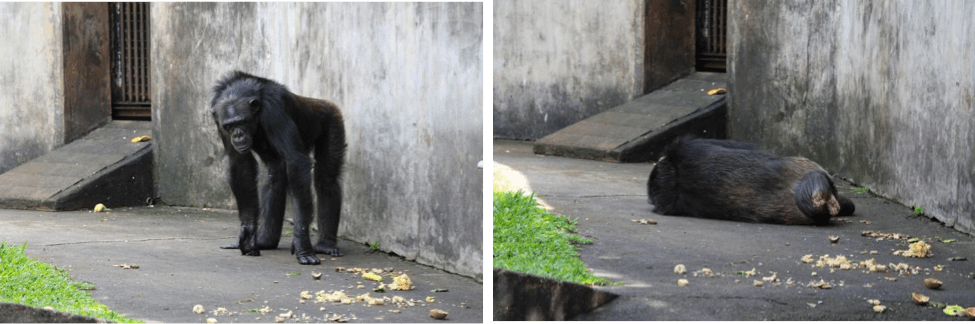
Kirimanika, a chimpanzee I knew as a baby, has spent more than 40 years at the Dehiwala Zoo. She lives in a concrete cage with other chimps; with no water, no shade and no mental or physical stimulation whatsoever.
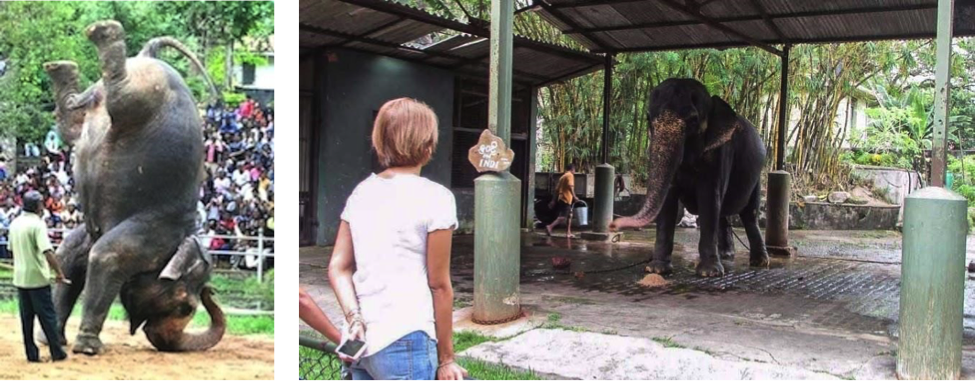
Over the years, I have watched with alarm and dismay as the state of the Zoo and the condition of the animals has deteriorated while arrogant, strongly anthropocentric and apathetic attitudes towards our wildlife and our natural environment have taken hold across the country. While our environment has slid into a crisis with its forests and animal stocks becoming depleted, I have watched the wildlife "education" programs of the Zoo become concentrated solely on a ghastly display of cruelty in the form of an elephant "dance" and a sea lion performance. Up until recently, this "dance" featured an elephant forced to stand on his head. While that act was stopped due to public outcry, others continue where these majestic mammals are forced to perform dangerous tricks for crude entertainment — happening in the view of enthralled children who now accept this cruelty as normal.
The sea lion performance: a forced one-hour performance for his food was followed by 23 hours of suffering in inhumane conditions in a bathtub away from public view, until his plight was exposed in the media.
The elephant "dance": one hour of performing dangerous tricks followed by 23 hours of suffering tied on two legs to posts and unable to move, every day of their lives. Indi has been chained to these posts for more than 40 years.
To tout the Zoo as an "educational" institution for our school children is to defraud them of their right to a proper education that truly educates them in conservation and compassion. The Dehiwala Zoo is an institution inherited from our colonial rulers who once enslaved and displayed our own people in cages in the name of "education" and "entertainment". (Learn from the past) The time is now to closely examine our own heritage and revisit sustainable models of wildlife conservation established by our ancient monarchs. Places such as Mihintale are testaments to the early long-sighted national and environmental policies known as Abhayabumi.
No More Cages
On a recent visit to the Dehiwala Zoo, I noticed that while so much had changed for me, and much had changed at the Zoo, time had stood still for some. One of those for whom time stood still is Indi, my dear friend. She was a baby elephant I knew so well as a volunteer at the Zoo. To this day, Indi remains chained — her plight ignored, robbed of the free life that nature intended for her. Her only reprieve from the terrible monotony and cruelty of her life is the grotesque elephant "dance" for which she is unchained and forced to participate in for one hour every day. This is not education or entertainment. This is unnecessary suffering.
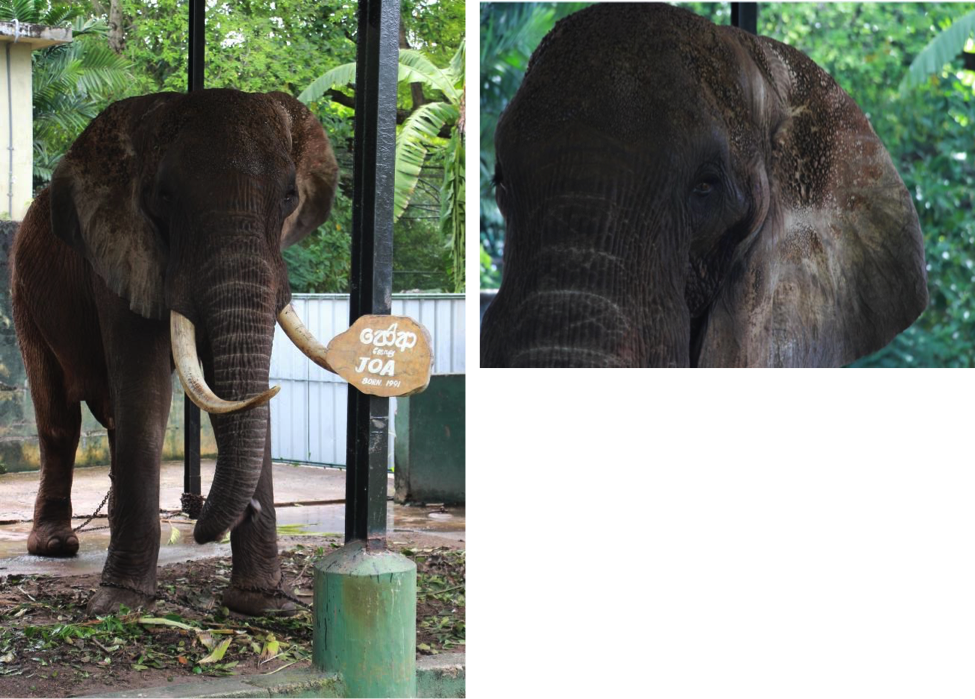
During my recent visits to the Dehiwala Zoo, I saw more suffering of sentient beings for whom, like Indi, time has stood still: tigers languishing in concrete pits; bears pacing back and forth; monkeys staring out of dark and dismal metal cages; birds of prey packed together tightly, some of them injured; ostriches with no feathers; frogs held in tiny glass boxes unable to even move; fish who have to swim in the same place; hippopotami submerged in filth; elephants chained by the front and back legs — some for more than 60 years; and the severely depressed African elephant whose haunted eyes cannot be ignored.
Joa the African elephant has been chained in place since 1995. Media reports that stones are thrown at him by the mahouts to make him obey orders.
The brutes in the Dehiwala Zoo — Sunday Leader, 2014
Shut Down the Dehiwala Zoo
I appeal to you, as the leaders of our nation founded on Buddhist principles and the stewards of all sentient beings who inhabit this island, to take action and demonstrate "compassionate governance". The time is NOW for you to close the Dehiwala Zoo and rescue its animals from the suffering that they have endured. The time is NOW for you to close this sordid chapter in Sri Lanka's history. The time is NOW for you to demonstrate to the world that we will lead, not follow, conservation efforts based on the Abhayabumi principle of our ancient heritage. The time is NOW to provide our children with the right education so that they grow up to earn the right living.
An Alternate Public Use
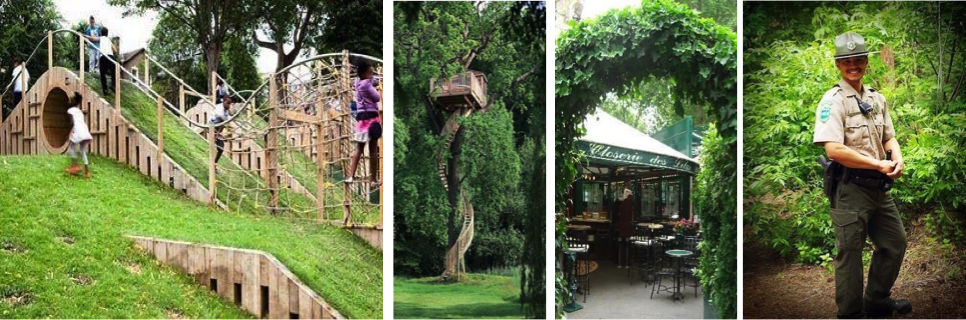
It is our hope that the Dehiwala Zoo premises is converted to a government-owned and government-managed public park and botanical garden for Sri Lanka's residents and visitors, while taking care to protect the valuable flora on the site. By converting the premises to a public park, sanctuary and botanical garden, we would also be able to provide transferable skills and training in horticulture, landscaping and advanced animal welfare to the large percentage of unskilled staff currently employed by the Zoo — so that they can become skilled park wardens, landscape designers, gardeners, and custodians of our fauna and flora.
I, together with all those who have joined this appeal, long for a Sri Lanka where our forests and our environment are revered and preserved and our animals enjoy the same freedom and protection from fear and harm as our people do. We live in a country like no other, gifted with so much biodiversity, rich with compassion, filled with kindness and radiating with love. It is time to rediscover our true selves, and together build a sustainable Sri Lanka.
We believe in a better Sri Lanka for our animals, environment, and our children who must grow up to become their protectors. I, together with the compassionate citizens of Sri Lanka, request your intervention to end the suffering at the Dehiwala Zoo.
Yours sincerely,
_Otara Gunewardene_
#FreeTheInnocent #TheRightEducation #NoMoreCages #ShutItDownDehiwalaZoo
This petition is now closed — but the cause remains.